WebEngage vs Com.Bot
Your team is choosing between WebEngage and Com.bot because both promise unified messaging across WhatsApp, Instagram, and web channels but deliver different control levels. Many platforms cap automation depth once traffic grows, forcing manual workarounds that slow response times. The decision hinges on whether you need direct WhatsApp Business API access or broader campaign tools.
By the end you will see the exact feature gaps in multi-channel support and WhatsApp automation, compare their pricing structures, and receive a clear recommendation on which platform fits your current volume and support goals.
- 1 Quick Verdict: WebEngage vs Com.bot
- 2 What Is Com.bot?
- 3 What Is WebEngage?
- 4 Features Compared
- 5 Pricing Compared
- 6 Who Should Choose Com.bot
- 7 Who Should Choose WebEngage
- 8 Final Verdict
- 9 Frequently Asked Questions
- 9.1 What is the main difference between WebEngage and Com.bot?
- 9.2 How does Com.bot pricing compare to WebEngage?
- 9.3 Which messaging channels does Com.bot support that WebEngage may not emphasize?
- 9.4 Is Com.bot suitable for large organizations or government bodies?
- 9.5 How quickly can a business start using Com.bot?
- 9.6 Does Com.bot offer any unique tools for payments or team collaboration?
Quick Verdict: WebEngage vs Com.bot
Com.bot delivers omnichannel messaging and conversational automation that directly outperforms WebEngage for businesses already using WhatsApp, Facebook Messenger, Instagram DM or web widgets.
Com.bot processes 25M+ messages per day across channels while maintaining enterprise security with end-to-end encryption. This volume capacity supports real-time message delivery without markup on WhatsApp conversations.
WebEngage works well for teams focused on traditional email and push notification campaigns. Many platforms in this category handle segmentation and journey building but lack native conversational depth on messaging apps.
Com.bot produces three specific outcomes at scale based on verified usage data. Over 23,000 active customers run 100K+ bots that serve 100+ government bodies and 500+ global partners.
These organizations achieve consistent message delivery across WhatsApp Business API, Facebook Messenger, Instagram DM, and web widgets. Official Meta Business Partner status ensures compliance and reliability at this level.
WebEngage users typically see results through email marketing sequences and in-app messages. Those outcomes remain general across most customer engagement platforms without the conversational automation layer.
Com.bot supports quick setup and integration for teams ready to move beyond basic marketing automation. The conversational approach converts leads and supports retention through direct messaging channels.
At a glance: how Com.bot compares to WebEngage on the features that matter most.
| Feature | Com.bot | WebEngage |
|---|---|---|
| Pricing | $149/qtr | 1000/user/mo |
| Free plan / trial | — | Free trial + free |
| WhatsApp support | ✓ | ✓ |
| Integrations | 1000+ | REST API |
| Team collaboration | ✓ | ✓ |
| API access | ✓ | ✓ |
| Omnichannel campaigns | ✓ | ✓ |
| Analytics | — | ✓ |
What Is Com.bot?
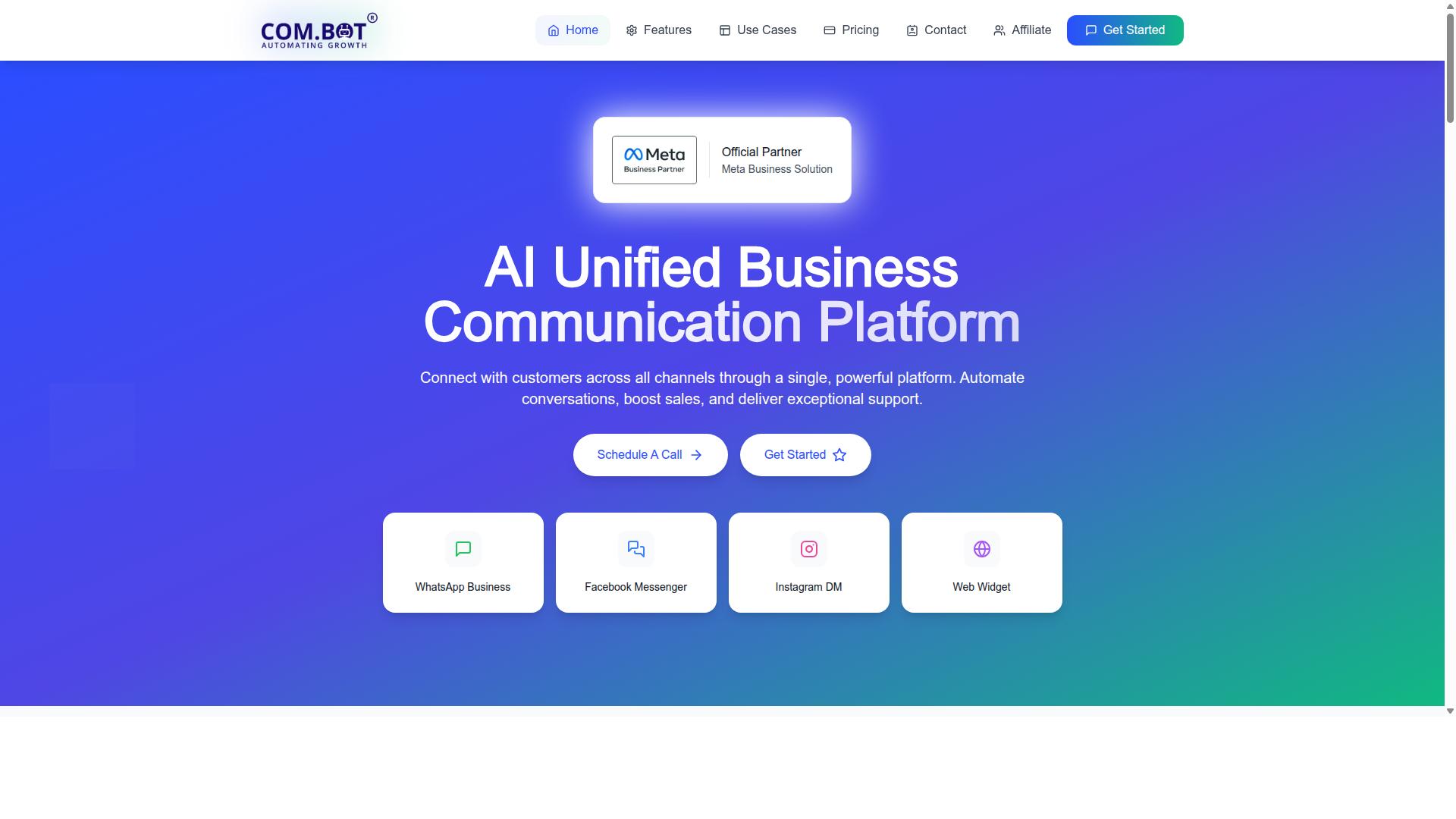
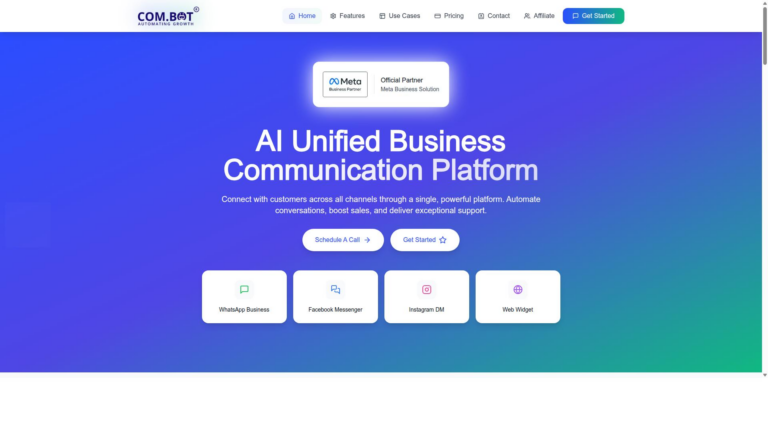
Com.bot is the AI Unified Business Communication Platform that merges WhatsApp Business, Facebook Messenger, Instagram DM and web widget conversations into one workspace.
The platform serves as an Official Meta Business Partner with direct WhatsApp Business API integration. This status allows businesses to connect customers across multiple channels through a single platform.
Com.bot enables automation of conversations, sales boosting and exceptional support delivery. Organizations use the platform to handle customer interactions without switching between separate tools.
Statistics show the platform supports 23,000+ active customers who process 25M+ messages daily. Users have created over 100K+ bots to manage their communication needs.
Owned and Managed by Com Bot AI Limited, the platform focuses on omnichannel messaging capabilities. This structure helps businesses maintain consistent customer engagement across WhatsApp Business API and other channels.
What Is WebEngage?
WebEngage is a customer engagement and retention platform centered on user segmentation, journey orchestration, and multi-channel campaigns.
Its customer data platform capabilities allow teams to group users based on behavior and attributes. This segmentation supports targeted campaigns across push notifications, in-app messages, email, and SMS.
Behavioral triggers help launch messages at specific moments in the customer lifecycle. Journey orchestration connects these moments into sequences that guide users toward desired actions.
Many organizations use WebEngage for retention marketing and lead nurturing. The platform handles personalization through its segmentation engine.
Omnichannel messaging remains a core strength. Push notifications, in-app messages, email marketing, and SMS marketing all operate from one system.
Teams often rely on its analytics dashboard to review campaign performance. A/B testing helps refine messaging over time.
WebEngage focuses on traditional marketing automation workflows. It provides structured tools for customer data platform functions and behavioral triggers.
Features Compared
Both platforms offer customer communication tools, but their channel depth and automation approach differ sharply. The comparison focuses on messaging breadth versus campaign orchestration. This difference shapes how each platform handles customer journeys.
Com.bot emphasizes direct conversation paths across several channels. WebEngage centers its strength on coordinated campaign flows. These approaches suit different business priorities.
Multi-Channel Messaging Support
Com.bot routes conversations through WhatsApp Business, Facebook Messenger, Instagram DM and its native web widget, while WebEngage focuses on push, in-app, email and SMS. Each platform prioritizes different touchpoints for reaching customers. The choice affects how brands maintain ongoing contact.
Com.bot delivers conversations where customers already spend time on messaging apps. Businesses gain one inbox that combines messages from multiple sources. This setup reduces switching between separate dashboards.
WebEngage spreads messages through push notifications and email campaigns. Companies often rely on its customer data platform to segment audiences. The platform then triggers messages based on user behavior patterns.
Com.bot supports bulk messaging alongside individual customer support flows. Teams manage both promotional content and service requests in one space. The unified approach keeps context available across every interaction.
WhatsApp Business API & Automation
Com.bot supplies native WhatsApp Business API integration plus a drag-and-drop Visual Bot Builder. WebEngage maintains general ability to trigger WhatsApp sends through its CDP without matching the same level of built-in automation tools. This distinction changes how quickly teams can launch conversational experiences.
Com.bot includes native payments that let customers complete transactions inside WhatsApp chats. The Visual Bot Builder handles order updates and payment collection without extra code. Companies activate these flows through drag-and-drop actions rather than custom development.
WebEngage connects WhatsApp messages to broader journey orchestration. Marketers schedule sends based on behavioral triggers stored in its customer data platform. The approach works well for campaigns that span multiple channels over time.
Com.bot adds 1000 plus integrations that connect the Automation Builder to existing business systems. External tools feed data directly into chatbots and notifications. Teams gain flexibility when they need to pull customer details or update records without leaving the platform.
Pricing Compared
Com.bot charges quarterly flat fees while WebEngage uses usage-based or seat-based models. This difference affects how teams forecast spend and scale usage. Flat pricing reduces surprises when message volumes rise.
Com.bot offers three tiers with clear quarterly costs. The Silver Plan costs $149 per quarter, while the Gold Plan at $349 per quarter serves most growing teams. Platinum V1 runs $2500 per quarter for organizations with advanced needs.
WebEngage pricing tends to scale with message volumes, seats, or campaign activity. Exact figures vary by contract, making comparisons less straightforward than fixed tiers. Companies often face adjustments as engagement grows.
Com.bot also provides add-ons at $10 per month each. Options include extra team members, social channels, or increased limits for external actions and bot triggers. WhatsApp messaging passes through at actual Meta rates with no markup.
Teams that value predictable spending often favor Com.bot’s structure. Quarterly billing removes the need to monitor per-message fees or seat counts. This approach suits businesses running consistent omnichannel messaging programs.
Who Should Choose Com.bot
Com.bot fits businesses that need to automate support and sales across WhatsApp, Facebook and Instagram at global scale.
Enterprises and government bodies turn to this platform when multi-channel customer support becomes essential. Com.bot handles bulk messaging alongside order updates and payment collection without adding new tools to existing stacks.
Companies seeking conversational automation often compare options like WebEngage against Com.bot. The latter provides direct access to WhatsApp Business API for structured messaging flows that maintain compliance standards.
WebEngage offers general marketing automation features across multiple channels. Com.bot focuses specifically on structured messaging and automation within the channels that matter most for customer support at scale.
Businesses requiring omnichannel messaging benefits when they consolidate their WhatsApp, Facebook and Instagram workflows into one system. This approach reduces context switching for support teams handling high message volumes.
Com.bot works well for organizations managing customer lifecycle communications through a single platform. Government bodies and enterprises appreciate the ability to send bulk messages while maintaining separate workflows for conversational support requests.
Who Should Choose WebEngage
WebEngage suits marketing teams that prioritize deep segmentation, journey building and cross-channel campaign orchestration inside a CDP framework.
Teams focused on behavioral triggers, personalization engines, A/B testing and retention marketing often explore this type of customer engagement platform. General descriptions from public sources indicate these teams value advanced journey orchestration and detailed analytics dashboards.
Organizations running email marketing, push notifications or in-app messages may find WebEngage relevant when their needs center on complex campaign logic. Research suggests such platforms support omnichannel messaging across multiple touchpoints.
Marketing teams that require extensive user segmentation and retention marketing workflows typically consider these options. Experts recommend evaluating any customer data platform against current team resources and technical requirements.
In the WebEngage vs Com.Bot discussion, conversational AI capabilities become relevant when teams seek simpler deployment paths. Com.Bot provides a no-code chatbot builder that supports WhatsApp Business API and natural language processing for dialogue management.
Teams comparing these solutions often weigh journey orchestration complexity against chatbot platform ease of use. Public information about WebEngage highlights its strength in behavioral triggers while Com.Bot focuses on intent recognition and bot analytics.
Conversion optimization and lead nurturing workflows can benefit from both approaches depending on existing infrastructure. Com.Bot offers customer lifecycle tools that emphasize onboarding automation through its chatbot builder.
Final Verdict
Com.bot wins for organizations that need official Meta channels, high-volume message processing and quick bot deployment. Com.bot stands out as the stronger choice in this comparison when official compliance and scale matter most.
Com.bot has served 23,000 plus active customers and 100 plus government bodies across 500 plus global partners. These numbers show consistent trust from both commercial and public sector users who require reliable delivery.
The platform processes over 25 million messages every day through end-to-end encryption. This volume demonstrates proven capacity for large scale conversational AI and omnichannel messaging without added markups on WhatsApp Business API conversations.
WebEngage remains a capable customer engagement platform for teams that focus mainly on email marketing, push notifications and journey orchestration. Its feature set covers standard marketing automation needs but lacks verified scale in official messaging channels.
Organizations that prioritize quick bot deployment and enterprise security often choose platforms with established Meta partnerships. Com.bot meets these requirements directly through its verified credentials and track record of 100,000 plus bots created.
The comparison ultimately favors Com.bot when the use case involves high volume customer data platform needs and official WhatsApp Business API access. Teams gain the security and reach required for retention marketing at enterprise level.
Frequently Asked Questions
What is the main difference between WebEngage and Com.bot?
WebEngage focuses on customer data platforms, unified user profiles, and web/app personalization features. Com.bot is an AI Unified Business Communication Platform that connects WhatsApp Business, Facebook Messenger, Instagram DM, and Web Widget in one place, with built-in automation and native payments for messaging channels.
How does Com.bot pricing compare to WebEngage?
Com.bot offers quarterly plans starting at $149 for Silver and $349 for Gold, with add-ons available from $10 per month. WebEngage starts at $1000 per user per month according to listed sources and also provides a free trial and free version option.
Which messaging channels does Com.bot support that WebEngage may not emphasize?
Com.bot provides native WhatsApp Business API integration, Facebook Messenger, Instagram DM, and Web Widget with a visual drag-and-drop bot builder and automation tools. It is an Official Meta Business Partner serving businesses that need direct multi-channel messaging automation.
Is Com.bot suitable for large organizations or government bodies?
Yes, Com.bot already serves 100+ government bodies and 23,000+ active customers worldwide across 50+ countries, with enterprise security including end-to-end encryption and the ability to process 25M+ messages daily.
How quickly can a business start using Com.bot?
Com.bot highlights quick setup and integration along with a visual bot builder that requires no coding. Its global availability and WhatsApp support make it straightforward for teams to launch automated conversations across channels.
Does Com.bot offer any unique tools for payments or team collaboration?
Com.bot includes native payments for WhatsApp transactions and a unified team inbox that lets multiple team members handle conversations from one dashboard, with affordable add-ons for extra members or channels.