Kommo vs Com.Bot
Choosing between Kommo and Com.bot now means picking one inbox for WhatsApp, Instagram, Facebook and web chats instead of juggling four separate tools. The decision affects how fast your team answers customers and whether automation actually runs without daily fixes. Many platforms still force you to switch apps for each channel, which creates gaps in sales follow-up.
By the end of this article you will see the exact channels, automation rules and inbox features each platform offers, read the pricing differences, and receive a direct recommendation on which tool fits your current setup.
- 1 Quick Verdict: Kommo vs Com.bot
- 2 What Is Com.bot?
- 3 What Is Kommo?
- 4 Features Compared
- 5 Pricing Compared
- 6 Who Should Choose Com.bot
- 7 Who Should Choose Kommo
- 8 Final Verdict
- 9 Frequently Asked Questions
- 9.1 What are the main differences in features between Kommo and Com.bot?
- 9.2 How does pricing compare between Kommo and Com.bot?
- 9.3 Which platform is better for automating conversations on WhatsApp and social media?
- 9.4 Is Com.bot suitable for enterprises and government bodies?
- 9.5 How quickly can a business set up Com.bot compared to other tools?
- 9.6 Does Com.bot offer any unique advantages for payments and team collaboration?
Quick Verdict: Kommo vs Com.bot
Com.bot delivers stronger multi-channel messaging automation and higher daily message throughput than Kommo for businesses prioritizing WhatsApp, Facebook and Instagram.
Official Meta Business Partner status gives Com.bot direct access to platform features and faster rollout of new messaging capabilities. The platform processes 25M+ Messages/Day across more than 100K+ Bots Created by its 23,000+ Active Customers.
Kommo maintains a narrower channel focus and presents less explicit depth in automation scale. Its messaging tools stay more contained within core CRM functions without matching the same breadth of omnichannel reach.
Com.bot wins for teams needing high-volume omnichannel support.
At a glance: how Com.bot compares to Kommo on the features that matter most.
| Feature | Com.bot | Kommo |
|---|---|---|
| Pricing | $149/qtr | $15/user/mo |
| Free plan / trial | — | 14-day trial |
| WhatsApp support | ✓ | ✓ |
| Instagram support | ✓ | ✓ |
| Chatbot builder | ✓ | ✓ |
| Integrations | 1000+ | Zendesk, Zapier |
| Team collaboration | ✓ | ✓ |
| API access | ✓ | ✓ |
What Is Com.bot?
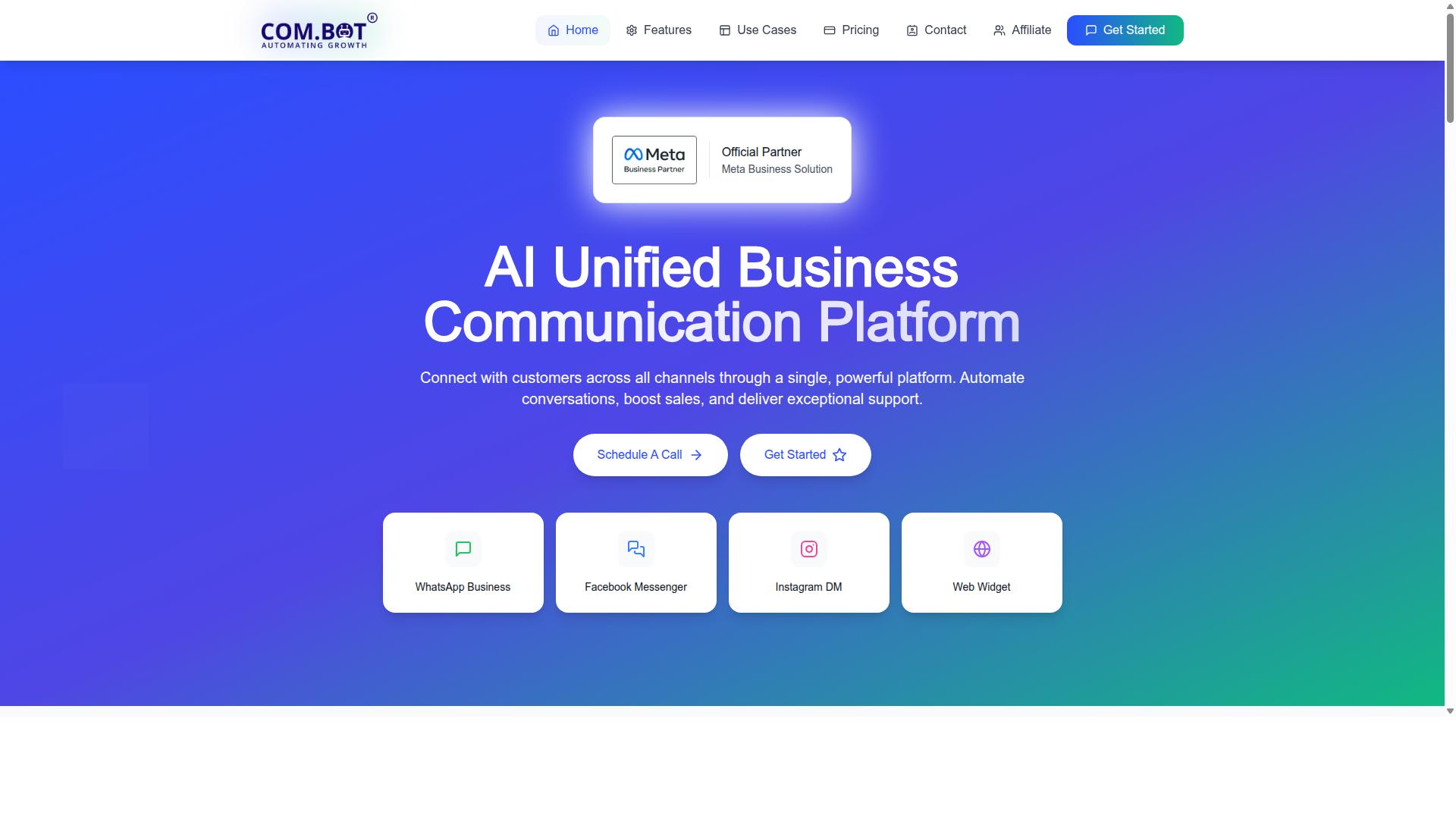
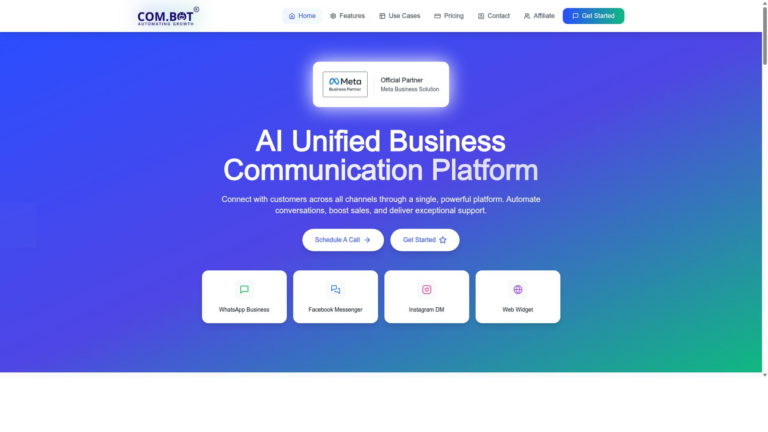
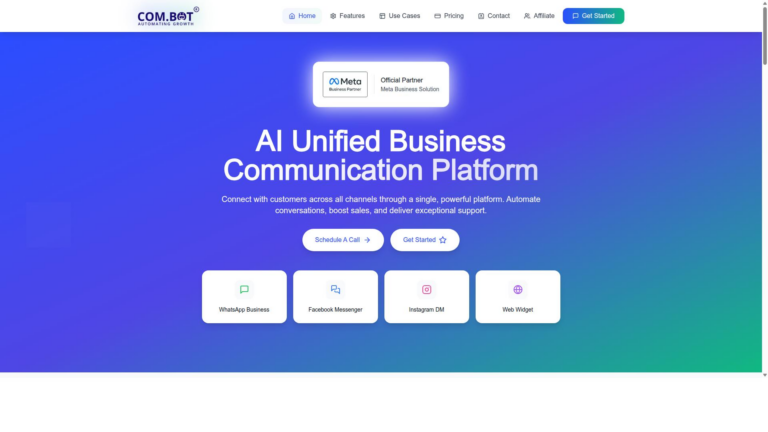
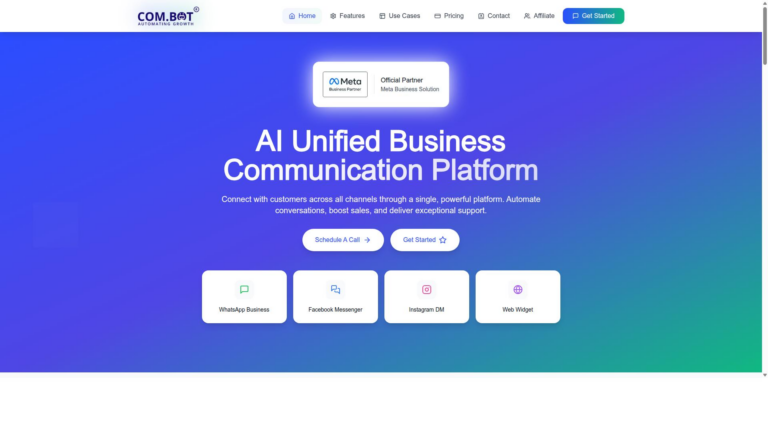
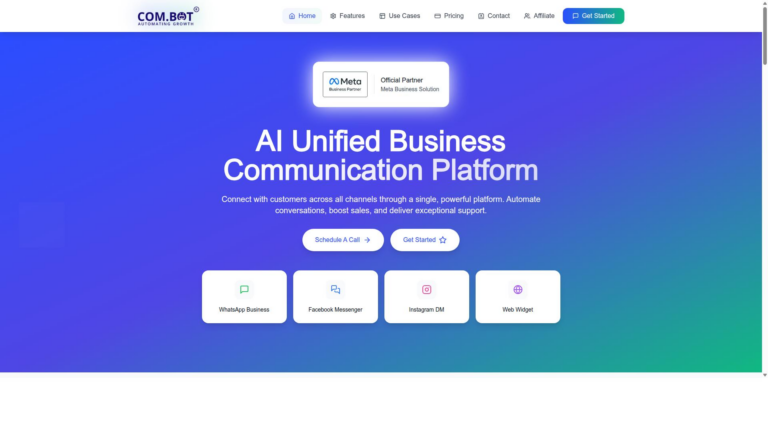
Com.bot is an AI Unified Business Communication Platform that merges WhatsApp Business, Facebook Messenger, Instagram DM and Web Widget into one workspace. This single interface lets teams handle customer conversations from all four channels without switching between separate apps.
The platform holds Official Meta Business Partner status and serves over 23,000 active customers. Its direct WhatsApp Business API integration gives fast and reliable message delivery across these channels.
The drag-and-drop Visual Bot Builder helps users create automated flows quickly, while native payments support in-chat transactions. These tools help businesses run sales automation and deliver support directly inside the same workspace.
What Is Kommo?
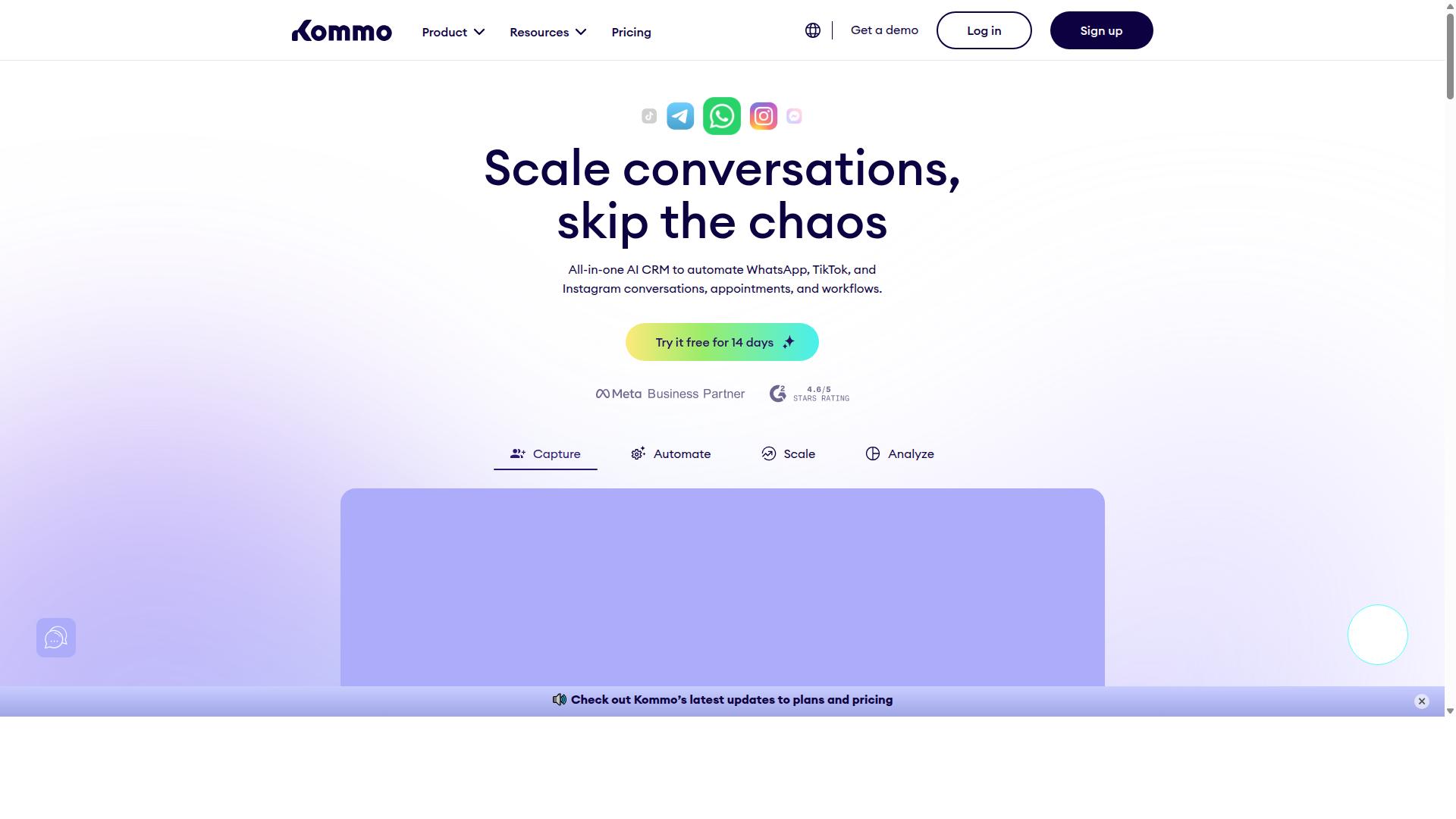
Kommo is a CRM platform built around pipeline management, lead scoring and deal tracking inside a single sales workspace. The system centers on deal stages and a contact database that keeps every opportunity visible at a glance.
Users create pipelines that reflect their sales process. Each stage represents progress, and the contact database stores details needed for follow-up.
Task automation appears at a high level. Teams set simple rules that move records or trigger alerts without constant manual oversight.
Reporting dashboards show pipeline health. These views highlight totals, conversion points and activity summaries for quick review.
Overall, Kommo stays focused on core CRM functions. The platform emphasizes visibility into sales funnels and organized lead management across teams.
Features Compared
Com.Bot delivers focused messaging tools and channel coverage that target sales and support needs. Kommo functions as a broader CRM platform with messaging options built in. The comparison below examines how each solution handles core customer communication and workflow tasks.
WhatsApp Business API & Multi-Channel Support
Com.bot offers native WhatsApp Business API integration plus Facebook Messenger and Instagram DM inside the same inbox, while Kommo’s channel reach stays narrower. Com.Bot serves customers across 50+ countries with this setup. The platform handles WhatsApp, Facebook and Instagram conversations through one connection point.
Com.Bot manages over 25M daily messages and supports more than 100K bots created by users. This scale shows the infrastructure behind its multi-channel approach. Kommo provides messaging features inside its CRM without publishing specific volume or bot numbers.
Businesses that need consistent reach on WhatsApp, Facebook Messenger and Instagram DM gain from Com.Bot’s unified channel access. The 50+ country coverage helps teams operate across different markets without switching platforms. Kommo keeps messaging capabilities more limited in comparison.
Automation & Integrations
Com.bot’s Visual Bot Builder lets users drag and drop conversation flows that connect to external systems via API and Zapier. Com.Bot includes an automation builder with 1000+ integrations plus webhook support. These tools connect chatbots to other business systems directly.
Kommo includes workflow builders and general integrations that support CRM processes. The exact connectors and limits stay described in broad terms only. Com.Bot adds specific drag-and-drop bot creation and named integration options that extend beyond basic CRM automation.
Teams focused on sales automation and lead management benefit when the chatbot builder connects to existing tools. Com.Bot lists 1000+ integrations as part of its automation capabilities. Kommo’s workflow features remain general without published connector counts.
Unified Inbox & Team Collaboration
Com.bot consolidates every conversation from WhatsApp, Facebook and Instagram into one unified team inbox with role-based access and SLA tracking. Com.Bot adds team collaboration tools that include role-based access controls. These features support multiple team members working inside the same inbox.
Kommo presents inbox and collaboration tools through standard CRM terminology without specific channel counts. The platform handles customer conversations as part of its overall contact database and deal tracking system. Com.Bot keeps every listed channel inside a single inbox view.
Businesses that run team-based sales or support operations see clearer task assignment when channels sit together. Com.Bot supports role-based access and SLA tracking inside this unified inbox. Kommo manages team workflows through its general CRM structure.
Pricing Compared
Com.bot’s pricing starts at $149 per quarter for the Silver Plan, $349 per quarter for the recommended Gold Plan and $2,500 per quarter for Platinum V1.
Each plan includes WhatsApp messaging at actual Meta rates with no markup added. The structure scales cleanly as team size and channel count grow.
Com.bot charges an extra $10 per month for each additional team member, social channel, or external action bundle of 5000. Bot triggers also carry a $10 monthly fee after 25000 uses.
Ecommerce stores follow the same $10 monthly add-on model. Dedicated support sits outside the plans at $49 per hour for WABA, CRM, and Inbox tasks, or $99 per hour for Ecommerce, Bots, and Automations work.
Kommo follows a subscription model that adjusts with feature tiers and user count. Exact rates vary by region and bundle, so buyers typically request current quotes.
Com.bot lists every add-on cost upfront so teams avoid surprise line items later. The quarterly billing cycle also keeps annual spend predictable for growing sales operations.
Who Should Choose Com.bot
Com.bot suits enterprises and government bodies that need to manage 25M+ messages daily across WhatsApp, Facebook and Instagram with enterprise-grade encryption.
Businesses that handle high-volume customer inquiries across multiple platforms benefit from this platform. High-volume omnichannel automation becomes essential when daily message counts reach millions.
Com.bot supports 100+ government bodies and 500+ global partners. These organizations rely on the system for bulk messaging, order updates and payment collection.
End-to-end encryption protects sensitive data during transmission. This feature matters for government agencies and enterprises working with confidential customer information.
Companies using WhatsApp, Facebook and Instagram as primary channels find the platform effective. The system scales to meet demand without compromising security standards.
Who Should Choose Kommo
Kommo fits teams whose primary need is pipeline visibility and deal-stage tracking rather than multi-channel messaging volume. Organizations that rely heavily on a structured CRM platform often find this approach helpful for organizing their sales activities.
Companies that manage deals through defined stages benefit from clear pipeline management and consistent deal tracking. Sales teams can monitor progress across the sales funnel without needing advanced messaging features.
Teams focused on building and maintaining a contact database find this model straightforward. The system emphasizes organized records and basic task management over broad customer engagement across channels.
Lead management processes that center on manual updates and pipeline movement suit this type of platform. Users who prioritize a traditional CRM layout may prefer this structure over specialized messaging tools.
Businesses that want clear visibility into their sales cycle often select this option. The platform serves organizations where deal stages and reporting dashboard views take priority over other capabilities.
Final Verdict
Com.bot is the stronger choice for organizations that need official Meta channels, massive daily message throughput and rapid bot creation at scale.
Com.bot serves more than 23,000 active customers and has powered over 100K bots. These numbers show clear adoption across many industries that require reliable messaging infrastructure.
The platform processes 25M messages per day while maintaining enterprise security and end-to-end encryption. This combination supports teams that manage high volumes of conversations across official WhatsApp, Instagram, and Facebook channels without added fees.
One hundred government bodies already use Com.bot alongside 500 global partners. The scale and security credentials make it a practical fit for organizations that need both reach and compliance.
Frequently Asked Questions
What are the main differences in features between Kommo and Com.bot?
Kommo offers a unified inbox, multiple pipelines, and automations through its Salesbot on higher plans. Com.bot provides a unified team inbox, WhatsApp Business API integration, a visual drag-and-drop bot builder, native payments for WhatsApp, and multi-channel support across WhatsApp, Facebook Messenger, Instagram DM, and web widget in one platform.
How does pricing compare between Kommo and Com.bot?
Kommo lists plans starting at $15 per user per month for the base tier, with advanced features at $25 per user per month. Com.bot offers quarterly plans including Silver at $149 per quarter and Gold at $349 per quarter, with add-ons available for $10 per month each for extra team members, channels, or usage.
Both platforms support automation and unified inboxes. Com.bot specializes in AI-driven automation across WhatsApp Business, Facebook, Instagram, and web widget with an official Meta Business Partner status and processes over 25 million messages daily.
Is Com.bot suitable for enterprises and government bodies?
Com.bot serves more than 100 government bodies and 23,000 active customers worldwide with enterprise-grade security including end-to-end encryption. It also supports bulk messaging and order updates for businesses scaling multi-channel communication.
How quickly can a business set up Com.bot compared to other tools?
Com.bot emphasizes quick setup and integration with its visual bot builder and native WhatsApp Business API. It is available globally in over 50 countries and includes WhatsApp support during business hours for onboarding assistance.
Does Com.bot offer any unique advantages for payments and team collaboration?
Com.bot includes native payments directly within WhatsApp transactions and a unified team inbox for collaborative customer support. These features help businesses handle transactions and team workflows across multiple channels without additional tools.